
Senator Bam Aquino and alliance of over 250 multi-sectoral organizations is mounting a relentless push for the House of Representatives to immediately pass the Citizen Access and Disclosure of Expenditures for National Accountability (CADENA) Act, citing over P1 trillion in budget red flags by civic watchdogs in the proposed 2027 national budget.
The Senate unanimously approved Aquino’s landmark measure (Senate Bill No. 1506) on third and final reading via a 17-0 vote in December 2025. However, the counterpart measure has languished in the House of Representatives for nearly nine months without action.
Aquino emphasized that the CADENA Act is the shield to permanently end hidden line-items, politicized pork and untraceable public spending.
“Macha-chat GPT mo na practically anything pero ‘yung pera ng bayan hindi mo pa rin mahanap-hanap kung saan napunta… Uulitin ko, this is probably the strongest reform against corruption that we can do. Ilalabas mo ‘yung data kung saan napupunta ‘yung pera ng bayan,” he said.
Civic groups warn of systemic budget abuses that continue to prioritize political patronage over vital public services.
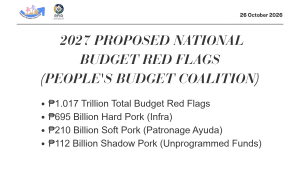
Sounding the alarm over massive fiscal misallocations, AJ Montesa of the People’s Budget Coalition uncovered more than P1 trillion in red flags embedded within the proposed 2027 National Expenditure Program (NEP).
According to the coalition’s breakdown, the dubious allocations comprise P695 billion in “hard pork” slated for politicized infrastructure projects, P210 billion in “soft pork” earmarked for patronage-driven social assistance (ayuda) programs and P112 billion in “shadow pork” tucked away in unprogrammed appropriations across various agencies.
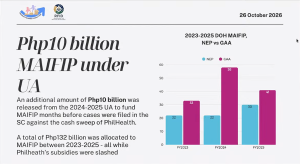
Montesa warns that the budget design traps ordinary Filipinos in a cycle of desperation where they must rely on political endorsements just to secure basic healthcare and emergency relief.
“It seems that the House wants us to get more sick so that we can beg more for our hospital bills,” Montesa said.
Aquino directly challenged lawmakers in the lower chamber to honor their duty to the public, questioning why a bill meant to protect taxpayers’ money is being stalled.
“It’s still a priority measure, pero we have to hold our colleagues accountable and really push that this is done and passed soon… Kung hindi pa natin ‘to gagawin, ibig sabihin no’n ayaw natin ng transparency. Ayaw na ayaw natin na makita ng taong bayan kung saan napupunta ‘yung pera nila,” Aquino said.
The drive to pass the CADENA Act has mobilized an unprecedented movement across civil society, technology sectors, and Congress.
Civic organizations ranging from good governance NGOs to tech firms and private volunteershave backed the bill, offering to build the blockchain platform for the government free of charge.
“Alam ho natin na kapag napasa po ‘yong CADENA, lahat ng mga mailalantad na po. Lahat ng mga kontrata mailalantad na po. Lahat ng pinupuntahan ng pera ng bayan mailalantad… Kung mayro’n po mang pumipigil ng CADENA, … siguro po ‘yon ‘yong mga tao na natatakot na may mailantad,” Aquino said.
If enacted, the CADENA Act will mandate an immutable, tamper-proof digital ledger where every peso of the national budget from appropriation to procurement and final disbursement is publicly viewable in real time.
“Kaya ituloy po natin ang usapan online, i-share natin ‘to at patuloy tayong manawagan na ipasa na ang CADENA Blockchain the Budget Bill para ang perang bayan, mababantayan!,” he concluded.