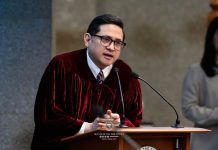
Peace advocate Adolfo Paglinawan, Vice President for Internal Affairs of the Asian Century Philippines Institute for Strategic Studies, Inc., was the keynote speaker at the “No to War: A Media Forum on Peace in Asia” held Friday at the Grand Men Seng Hotel, emphasized the urgency of keeping the Philippines out of escalating tensions between global powers.
“We came to Davao City to manifest our continuing caravan for peace for posterity ng Pilipinas,” he said.
He recalled that the peace campaign began in 2023 in Tuguegarao, Cagayan, when local leaders opposed the inclusion of the province as a site for U.S. military facilities under the Enhanced Defense Cooperation Agreement (EDCA).
Since then, the group has conducted similar peace advocacy activities in Cebu, Cagayan de Oro, and other parts of the country, maintaining a firm stance against the presence and buildup of foreign military forces on Philippine soil.
Paglinawan warned that war would not address the country’s current challenges, but would instead risk dragging the nation into a conflict that could harm future generations.
“We believe that war will not solve any of the present problems we have in this country. It would be entirely unjust for the Filipino people, particularly the younger generations, to be exposed to the elements of war—at a time when other ASEAN nations are progressing through economics and prosperity, while we risk becoming a proxy for U.S. interests in a potential conflict with China over Taiwan,” he said.
He also questioned recent statements from the Philippine government signaling readiness for possible conflict.
“We don’t see any justification—not even rhetoric—from the President of the Philippines, who, through AFP Chief of Staff Gen. Romeo Brawner Jr., announced preparations for a possible war involving Taiwan. We believe that the Taiwan issue is internal to China. There is nothing we can do about it, and nothing good will come out of being involved,” Paglinawan said.
Paglinawan called on the Philippine government to uphold international law and national sovereignty, rather than aligning with the strategic interests of the United States in the Asia-Pacific region.
He cited recent incidents—such as the deployment of the Philippine Coast Guard vessel BRP Suluan near Scarborough Shoal—as examples of actions that could provoke further tension.
“Real change, as former President Rodrigo Duterte once said, is what the country needs. But what we’re seeing today is not real change—it’s loose change, barya,” Paglinawan remarked.
The media forum was organized by the Asian Century Philippines Strategic Studies Institute, a think tank focused on governance, peace, and policy research. The organization also contributes to policy reviews involving the Bangsamoro peace process and the National Task Force to End Local Communist Armed Conflict (NTF-ELCAC).